Creating Your Workspace and Building Context
How Grantable builds organizational context from your documents — and why the Boilerplate skill is the fastest way to get set up.
- Getting Started
- How Grantable Understands Your Organization
- The Boilerplate: Your Reusable Content Library
- Why This Matters More Than You Think
6 min
reading time
Interactive knowledge check
Creating Your Workspace and Building Context
Your workspace is where everything lives in Grantable — documents, conversations, funder research, and your team’s shared context. But the real power isn’t in the workspace itself. It’s in what the AI can do once it has enough of your materials to work with.
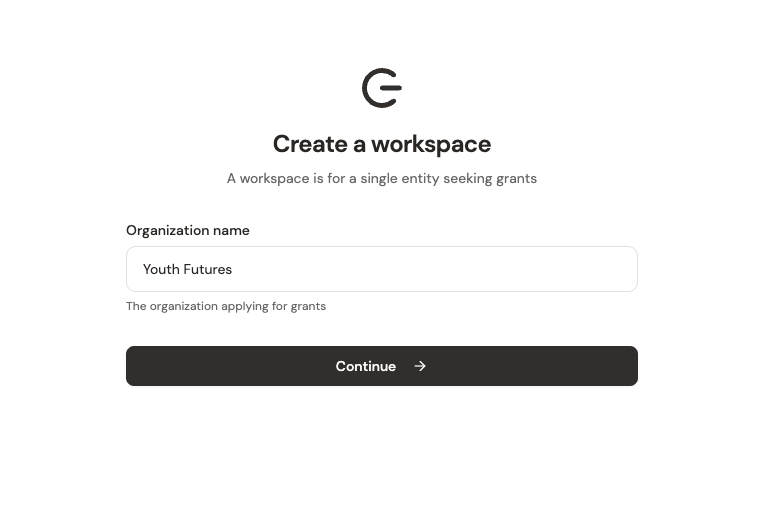
Getting Started
When you first create an account, Grantable gives you the option to upload existing documents or provide your website URL so it can scrape information about your organization. This step is completely optional and skippable — you don’t need to dump everything in at once.
That’s an important mental model: you can upload materials to Grantable at any time, as you need them. There’s no pressure to front-load a bunch of setup work. Every document you add makes the AI smarter about your organization, whether it’s day one or day one hundred.
How Grantable Understands Your Organization
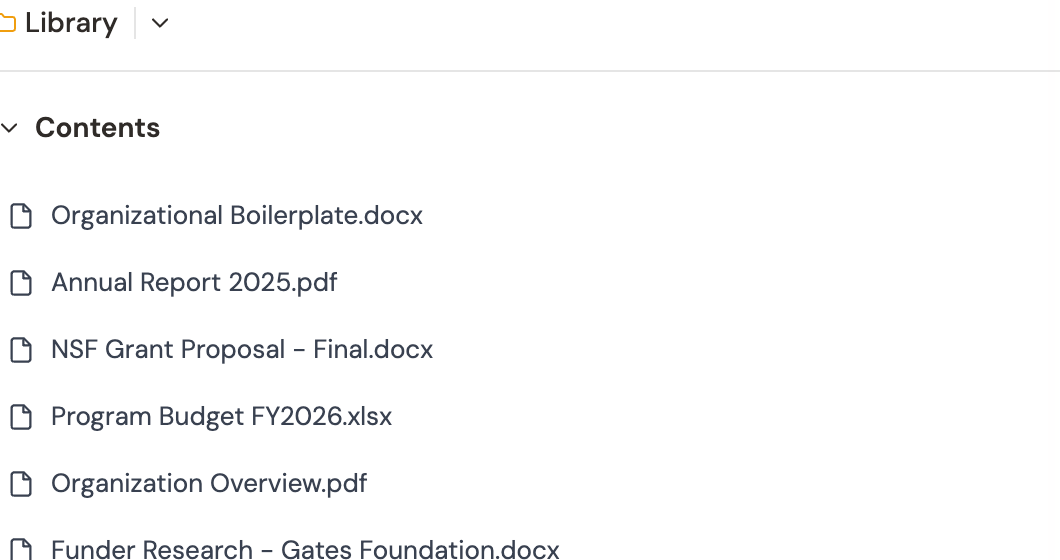
Here’s the key idea: Grantable can intelligently search your entire workspace library. When you upload past proposals, annual reports, program descriptions, or board documents, the AI can find and reference that information in any conversation. It doesn’t need you to point it to the right file — it searches across everything.
This means that if your library has enough of the right materials, the AI already knows who you are, what you do, and how you talk about your work. It can match funders, draft proposals, and answer questions based on what it finds in your documents.
Your workspace library is your organizational context. The more relevant materials you upload over time — past proposals, program reports, financials — the better every AI interaction becomes. You don’t need to do this all at once.
The Boilerplate: Your Reusable Content Library
Once you have a few documents in your workspace, the fastest way to get Grantable working well for you is the Boilerplate skill. Type /boilerplate in a conversation, and Grantable will scan your library, extract reusable content from your existing materials, and organize it into a single structured document.
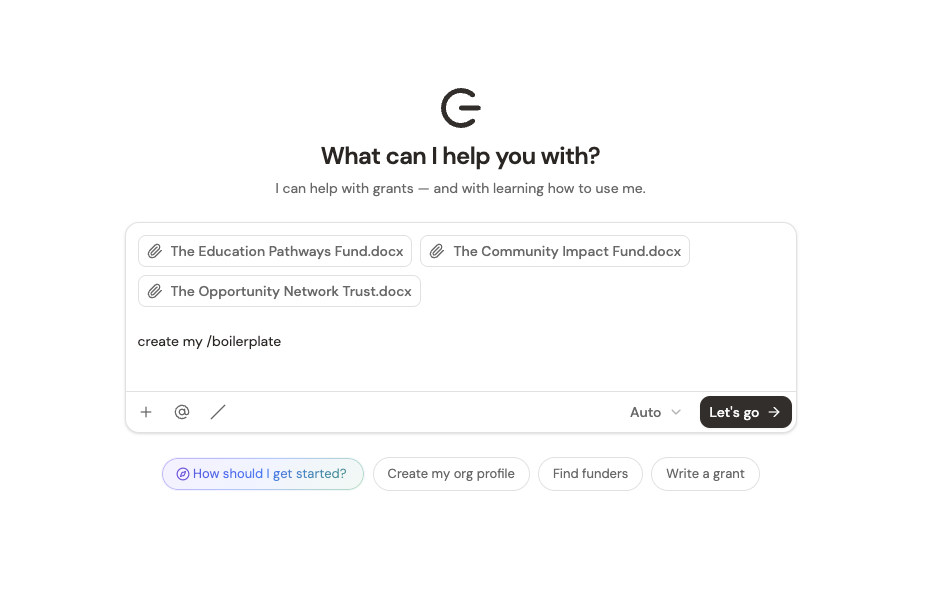
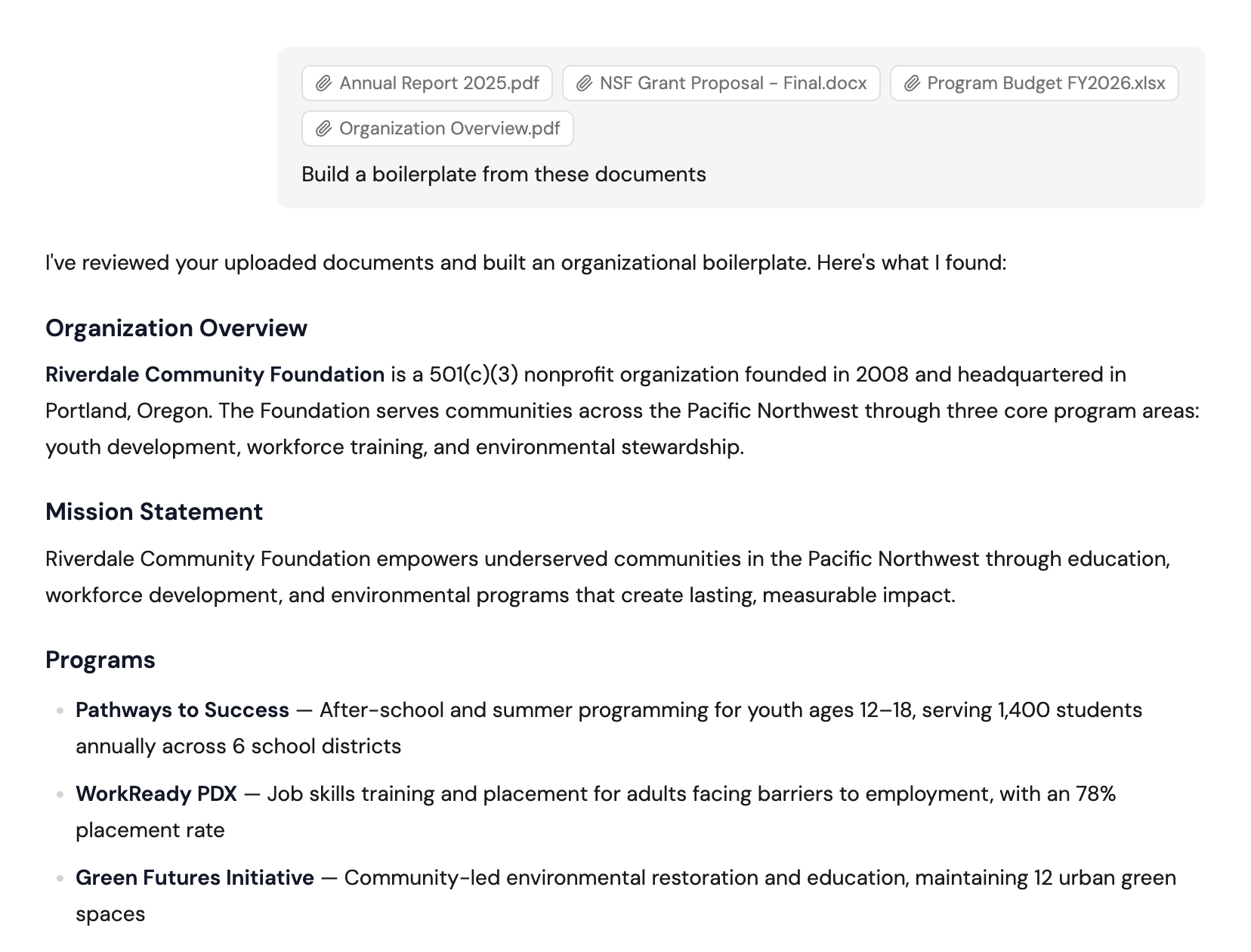
Your boilerplate file lives at /Library/{OrgName} - Boilerplate - {Year}.md and contains the sections you use in almost every grant application:
Mission & history
Multiple versions of your mission statement (one-sentence, one-paragraph, full) plus your founding story and key milestones.
Program descriptions
Each major program with the populations you serve, outcomes data, and geographic focus — written grant-ready.
Organizational capacity
Budget overview, staffing, infrastructure, and past grant successes that demonstrate you can deliver.
Key statistics & outcomes
The numbers that make your case — people served, outcomes achieved, impact metrics — organized so you can drop them into any proposal.
The AI pulls from this boilerplate whenever you’re writing a proposal, so the better it is, the better your first drafts are. But it also adapts — when Grantable uses boilerplate content in a grant application, it tailors the language to match each funder’s priorities and evaluation criteria.
You can also upload documents directly into the conversation — a past proposal, your annual report, a program brochure — and the Boilerplate skill will extract what it needs. This is often faster than starting from scratch. Successful past applications are especially valuable because those sections already worked.
Why This Matters More Than You Think
Think of it this way: without boilerplate, every proposal starts from zero. The AI has to search your library, figure out how you describe your programs, find your latest outcomes data, and piece it all together. It can do this — but it takes longer and the results are less consistent.
With a curated boilerplate file, the AI starts every draft with your best, most current language already in hand. Your mission statement is polished. Your program descriptions have the right outcomes numbers. Your capacity statement reflects this year’s budget, not last year’s.
You just joined an organization that has used Grantable for six months but never set up a boilerplate file. There are a dozen past proposals in the workspace. What's the fastest way to get set up?
This should take about ten minutes:
- Upload three key documents. Pick one successful past proposal, one recent funder report, and one organizational document (strategic plan, annual report, or similar). Drag them into the sidebar.
- Run the Boilerplate skill. Start a new conversation and type
/boilerplate. The AI scans your uploaded documents and extracts reusable content — mission language, program descriptions, organizational stats — into a single structured file. Review what it produces. Is the mission statement accurate? Are the key programs represented? Tell the AI what to fix and it will update the boilerplate. - Test the context. Start a fresh conversation and ask: “What do you know about our organization?” The AI’s answer should reflect everything from your uploaded documents and the boilerplate it just built. If it’s missing something important, that tells you what to upload next.
- Your workspace library is the real context engine — every document you upload makes the AI smarter
- You can upload materials at any time, not just during setup
- The Boilerplate skill extracts reusable content from your existing documents into a single structured file
- Good boilerplate means better first drafts on every proposal — the AI adapts it to each funder automatically
Next Lesson
Now that you understand how Grantable builds context, let’s look at how to bring your documents into the workspace — including cloud storage integrations.
Notice an error or have a question about this lesson?
Get in touchHave questions about this lesson?
Ask Grantable to explain concepts, suggest how they apply to your organization, or help you think through next steps.