Reading the Decision Matrix
Inside every Grant Opportunity Brief, the Decision Matrix is where the apply/pass call gets supported — three scored dimensions, a gaps-to-close list, and an effort estimate. How to read it, what the numbers actually mean, and how to turn it into a clear go-or-no-go.
- What the Matrix Shows
- Why Three Dimensions, Not Ten
- Using the Gaps List
- Pushing on the Matrix
5 min
reading time
Interactive knowledge check
Reading the Decision Matrix
Most grant teams waste time in two directions at once. They apply to funders that looked promising but were never a real fit — burning 40 hours on a proposal that was always a long shot. And they pass on funders they could have won, because the angle wasn’t obvious and there wasn’t time to figure it out.
The Decision Matrix is built to short-circuit both. It lives inside every Grant Opportunity Brief — the Brief is the full document; the Matrix is the scored section where “should we apply?” gets answered. It breaks the question into three readable dimensions, pairs that with the specific gaps you’d need to close before drafting, and estimates the total effort — so you can decide in minutes whether an opportunity is worth the hours.
What the Matrix Shows
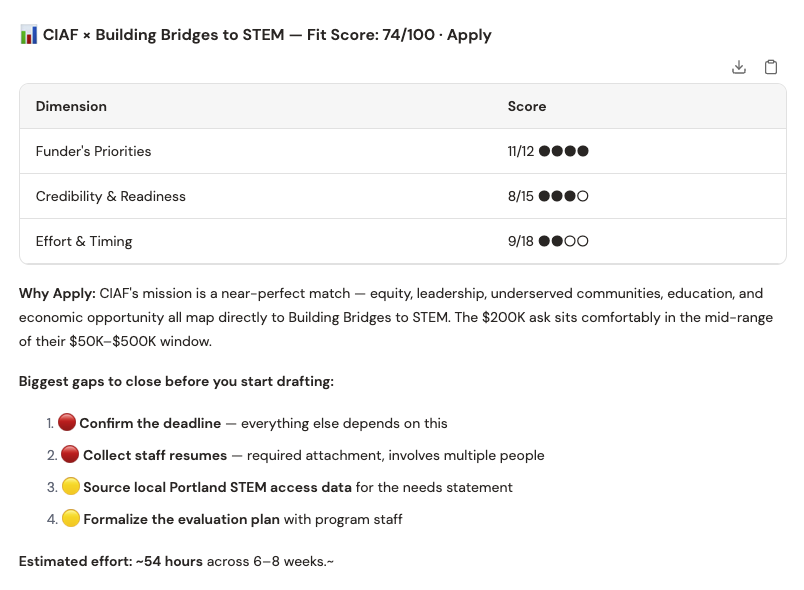
The card above is a summary view of three sections from a Grant Opportunity Brief, pulled together so you don’t have to scroll: the Decision Matrix (the three scored dimensions and the Why Apply narrative), Gap Analysis (the numbered list of what to close before drafting), and Effort Estimate (total hours + timeline).
The Matrix names the funder and opportunity and then gets straight to the evidence. There is no overall number and no one-word instruction to follow — the verdict is the Fit level, and it’s reported at the end of the summary alongside the dimension that’s holding it back. Below that, four working blocks:
Dimension breakdown
The three scored components of the Decision Matrix: Funder's Priorities (does this funder care about your work?), Credibility & Readiness (are you set up to win?), Effort & Timing (is it worth the hours given the deadline?). Each shows points earned, points possible, and a visual fill.
Why Apply (or Why Not)
A plain-English summary of what's driving the score. 'Mission is a near-perfect match — equity, leadership, underserved communities map directly to Building Bridges to STEM.' Reads the way a senior grant officer would brief you.
Biggest gaps to close before drafting
From the brief's Gap Analysis: a numbered list of specific tasks between you and a competitive proposal. Red indicators are must-dos that block the proposal; yellow are should-dos that strengthen it. 'Confirm the deadline,' 'Collect staff resumes,' 'Source local Portland STEM access data.'
Estimated effort
From the brief's Effort Estimate: total hours and a rough timeline — '~54 hours across 6–8 weeks.' Tells you what this application will actually cost the team.
Why Three Dimensions, Not Ten
A ten-factor score looks sophisticated but is impossible to act on — you can’t tell whether a 72 means “mission great, readiness weak” or “strong everywhere, marginal on two niche factors.” Three dimensions map directly to the three decisions grant leads actually have to make.
Funder's Priorities /12
Is this funder interested in what we do? Pulls from 990 giving patterns, focus area matching, and what the funder actually funds — not what their website claims. Four sub-criteria: geographic alignment, areas of interest, target population, type of support.
Credibility & Readiness /15
Do we have what it takes to make the case? Five sub-criteria: credibility with this funder, subject-matter expertise, fiscal expertise, project plan status, board/staff support. Gaps here are usually fixable — this is where the list of 'things to collect' lives.
Effort & Timing /18
Is it worth the work given the deadline, our capacity, and the expected award? Six sub-criteria: guidelines complexity, time available, financial audit requirements, match requirements, award timing, evaluation complexity. A small grant with a two-week deadline scores differently than the same grant with eight weeks.
Twelve plus fifteen plus eighteen equals 45 sub-criteria points. Those points are evidence, not a verdict — they are never rolled up into a single score. Grantable deliberately doesn’t print a 0–100 fit number, because one number hides exactly the thing you need to see: which dimension is weak.
The Matrix is decision support, not the decision. A Fair fit with a clean Gap Analysis and an 8-week runway is a real apply. The same Fair fit with five red-status gaps and a 10-day deadline is usually a pass. The dimensions and the gaps list tell you which — the level by itself doesn’t.
Using the Gaps List
The Gap Analysis is the part of the Matrix that changes how teams actually work. Instead of starting a proposal by staring at the RFP, you start by closing gaps — which is cheaper, parallelizable, and often reveals that the fit isn’t what the score suggested.
If you can’t close the red-status gaps in the first week, reconsider applying. A “must-do” gap you can’t clear isn’t a weakness you write around; it’s a reason to pass. Better to redirect the hours to a funder you’re actually ready for.
Pushing on the Matrix
The Matrix is a starting point. When you want to push on a dimension score or understand the reasoning, keep the conversation going:
“Why is Credibility & Readiness only 8 out of 15? What are we missing?”
“Compare this opportunity to the Meyer Memorial Trust one we scored last week — which should we prioritize given our team’s capacity?”
“What would Credibility & Readiness become if we added the Portland STEM access data you flagged as a gap?”
Grantable reads the Matrix, the Gap Analysis, the Effort Estimate, and the underlying 990 and RFP data — and can tell you not just where the gaps are but what closing them would buy you.
A grant opportunity comes back with a Fit of Fair. Funder's Priorities is 11/12 (strong), Credibility & Readiness is 8/15 (moderate with three red-status gaps), Effort & Timing is 9/18 (moderate — deadline is 10 days). What's the most useful read?
- The Decision Matrix lives inside every Grant Opportunity Brief — three scored dimensions (Funder's Priorities, Credibility & Readiness, Effort & Timing), a Why Apply summary, a Gap Analysis, and an Effort Estimate
- The verdict is a Fit level — Strong, Fair, Weak, or Blocked — reported from the fit assessment, never a 0–100 score; the dimensions and the gaps list are where the real read is
- Red-status gaps in the Gap Analysis are blockers; if you can't close them in time, pass rather than paper over them
- Push on the Matrix conversationally — ask Grantable what closing a gap would buy you, or how this opportunity compares to another
Next Lesson
The Decision Matrix is one section of a larger document. The full Grant Opportunity Brief also surfaces the Opportunity Summary, Application Requirements Inventory, a Question-by-Question Alignment that turns the RFP into writable chunks, and sharing tools that make it a team artifact, not just a decision-support doc. That’s next — the brief as a whole.
Notice an error or have a question about this lesson?
Get in touchHave questions about this lesson?
Ask Grantable to explain concepts, suggest how they apply to your organization, or help you think through next steps.