The Recent History of AI, in Six Eras

Prefer to watch? The whole history in nine minutes — or read on.
If your understanding of AI is basically unchanged since 2024, that's totally fine. Grant professionals are busy. They were busy before AI. And keeping on top of every breakthrough in artificial intelligence is a full-time job and then some — there are literally people on YouTube whose entire career is just keeping up with what the leading labs put out each week.
Meanwhile, the field itself keeps accelerating. One of the things making the change so fast is that the labs use their best models to help build the next, better model. Every generation gets better at building its successor, and the iterative cycle keeps shortening. Add in a horse race between Google, Anthropic, and OpenAI, all pushing each other, all releasing similar things weeks apart, and you get a pace no working professional should feel guilty about failing to track.
So if you figured out some useful tricks with a simple AI chat a couple of years ago, felt like that was enough, and got back to your actual work — that's what 99 percent of people did. Completely understandable.
But it's also true that these systems have gotten incredibly powerful, and it's a good time for a refresher. What I want to do here is lay out what I've been calling the eras of AI — the markers and milestones of a very short history, just a few years — so we can orient ourselves to what the technology is actually capable of today.
What counts as an era
First, the rule I'm using. A new era is when AI gains a truly new space of capability.
A clear example: the moment chatbots could search the internet. Before that, it was just you and the model inside one chat thread. After, it could go run searches, read websites, and come back to you with processed results — a whole new way to use the tool. That's a jump between eras.
Compare that to a model update, like Claude Opus 4.6 becoming 4.7 and then 4.8. Those improvements are real, but they're qualitative. It's a feel. People say "this one seems smarter." The model writes closer to what you wanted with less coaxing. There's no bright line where Monday you couldn't do something and Tuesday you could. It's more like Wednesday feels smarter than Tuesday.
Six new verbs have arrived since late 2022.
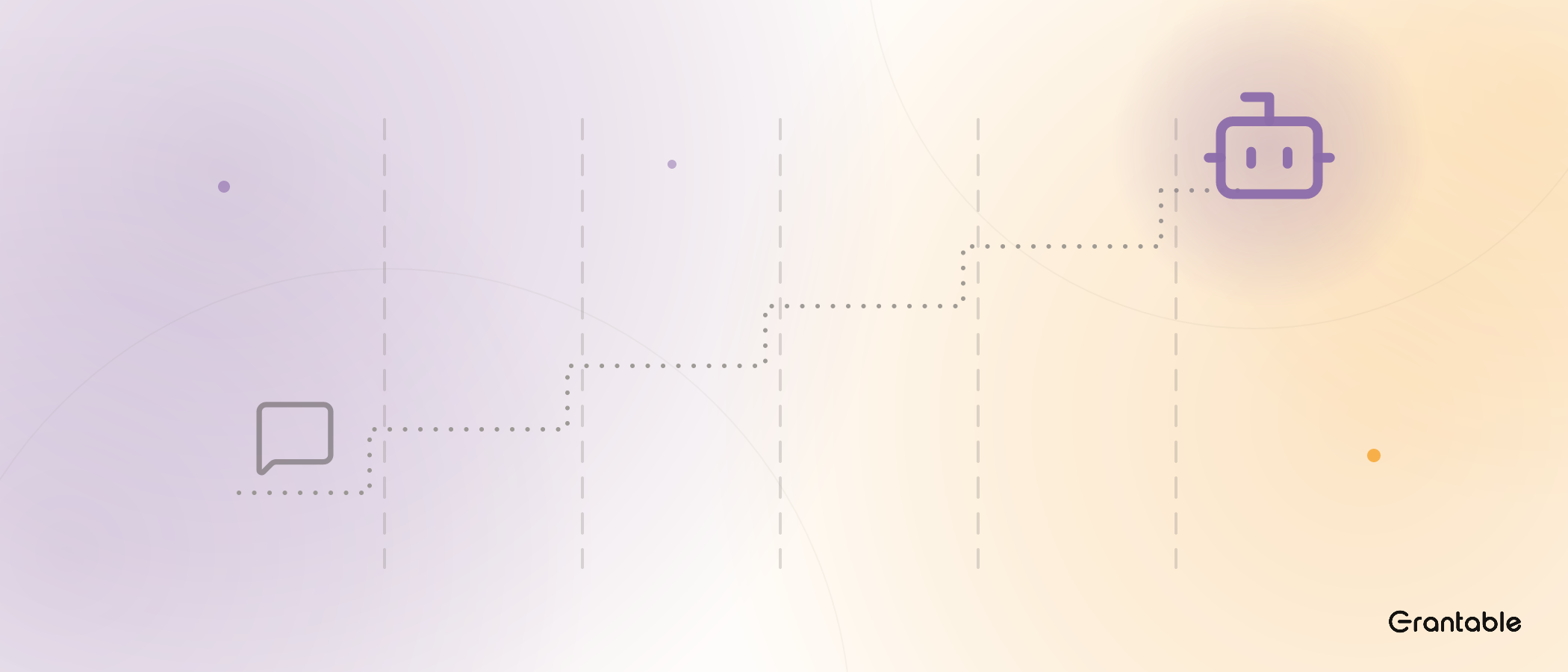
The six eras — each one a new verb. Tap for the one-page version.
Get the era timeline — free one-page PDF ↓
Era 1 · It talks (November 2022)
My first vivid experience with AI came right when ChatGPT launched, in late November 2022. I was with my in-laws in Asheville, North Carolina for the holidays, and we sat around the Airbnb passing this app back and forth, having our minds blown. We asked it to plan itineraries — and it came back with real restaurants, real activities, even dishes to try, from barely any prompting. It was wild. And eerie, honestly, because it wasn't searching the internet. All of that came from its training data, and none of us could really comprehend how.
As amazing as it was, looking back from now: it was just text. One chat thread, text in, text out. It couldn't see anything. It couldn't search anything. It had no memory and no tools. A brilliant text box.
Era 2 · It sees (2023)
Then came a shift I remember clearly: the thread stopped being text-only. You could generate images. You could upload a picture and it understood what was in it. You could feed it documents, even audio files, and it understood all of that context too. Within about a year of launch, ChatGPT gained voice and vision (September 2023) and image generation (October 2023), and Google's Gemini arrived built multimodal from day one (December 2023).
The text box got senses.
Era 3 · It reaches out (2023 → 2024)
When these chatbots could only write back to you, they could do thought work alongside you — clarify your thinking, teach you something, help you arrive at a checklist of things to do. But everything on that checklist that wasn't a piece of writing? You still had to go do it yourself.
Then AI started acting outside the chat window. Searching. Writing and running code. Operating other software — a capability that got its industry standard in late 2024, when Anthropic released the Model Context Protocol, the connector that lets an AI operate your systems, not just browse the public web. Now you could hand the AI a list of tasks that a human would do at a computer, and the computer could go do them itself, often shockingly fast.
This is the era jump I'd rank as most underrated: the AI went from being a talker to a doer.
Era 4 · It remembers (2024 → 2025)
Early ChatGPT had no continuity between threads. Tell it about your family on Tuesday, mention your brother again in a new chat two weeks later, and it had no idea who you meant. You started from scratch every time.
OpenAI changed that — saved memories arrived in February 2024, and by April 2025 ChatGPT could reference your whole chat history. In the background, an AI was quietly reading your threads, taking notes, and building a profile. Now you could come back weeks later and it already knew your brother William, and that he likes to bike.
And that was controversial, because in a way it's spying on you. It's building a dossier about who you are — and at the time you couldn't really see what was in the file. When Anthropic shipped its own version of memory in late 2025, enough people pushed back that it became something you explicitly turn on or off.
That controversy has mostly passed. People realized memory makes the AI dramatically more useful. What's interesting is where the cutting edge moved next: instead of letting the memory live inside somebody's platform, the people going deepest are building their own memory systems — organized folders of their work, their transcripts, their context — that they let the AI browse. They own it. The AI just reads it, and gets continuously smarter about their world.
This, by the way, is roughly where most of the nonprofit sector's mental model stops. If that's you — again, totally fine. But the next two eras are where the ground really moved.
Era 5 · It operates (2025)
In my whole AI journey, there has not been a bigger moment than when I started using Claude Code.
Some context for why. The vision for Grantable lived in my head for years. In 2020, when I started the company, the path for a non-technical founder went like this: raise hundreds of thousands of dollars, hire an engineering team — offshore, probably, to make it cheaper — then spend weeks in meetings and diagrams and documentation before seeing a single prototype. Then round after round of feedback, where I'd cram everything I possibly could into each pass, because I knew the next iteration would cost another ten or fifteen thousand dollars. Slow and expensive doesn't begin to cover it.
Now it's literally a conversation. The way I'm speaking into this microphone is how I build: I talk to Claude Code, describe what I want and why, ask it to interview me to pull out the details I forgot to mention — and I watch iterations render on my screen in minutes. I click around, I send back screenshots. This button's too hidden. This feels too busy. Minutes later, a new round.
What used to take months has been compressed into hours. Tools like this arrived in early 2025 and hit general availability that spring, and the era they opened is bigger than coding: AI that operates a computer the way a person does — files, terminals, browsers, whole workflows.
Era 6 · It runs alone (late 2025 → now)
The last era is the one unfolding right now, and its origin story says everything about it.
OpenClaw is an open-source project created by one person — Peter Steinberger, an Austrian developer building a tool for himself. What he wanted was the intelligence of an AI model that's on all the time, maximally capable and autonomous. Able to do everything a person can do on a computer. If it hits an obstacle, it loops and tries another way around. And you talk to it through the messaging apps you already use — WhatsApp, Telegram, Slack.
It took off like wildfire: roughly 3.2 million people use it monthly, with over half a million instances running. None of the big labs built this. It came from the community — and then a lab absorbed it, when Steinberger joined OpenAI in February 2026.
Part of why it got so much attention is the genuine risk. People connected these agents to their email, their money, their accounts, and just… let them go. Some found it thrilling. Some got into real trouble. That frenzy has cooled a bit, and now every major technology company is working on the disciplined version: hierarchies of agents, often called harnesses, where fleets of AIs work in parallel at different levels of autonomy and report up a chain — to more senior agents, and eventually to the humans managing them. Anthropic shipped its version in May 2026, orchestrating up to a thousand agents on a single task.
The whole point is multiplying how much work gets done at once — including agents whose entire job is managing other agents.
The one number that cuts through all of it
If you want a single measure to track across every era, I think it's this: how long can AI work without supervision?
A research group called METR has been measuring exactly that. Their method: take real, difficult tasks and first measure how long a skilled human expert needs to complete them. That expert time becomes the yardstick for how big the task is. Then hand the same task to the AI — completely unassisted, no human help in the middle — and see if it can finish.
As of February 2026, frontier models complete tasks that would take a human expert about fourteen and a half hours. Call it two full working days of expert work, done without supervision — the AI problem-solving, looping, and finding its own way to the finish.
The one number to track across every era.
Maybe more astonishing than the number is its trajectory: it has been doubling roughly every four months. If the trend holds, the math gets vertiginous fast — thirty hours, then sixty, then a hundred and twenty. That's the through-line running underneath all six eras, and it's still climbing.
What to do about the gap
So there's a gap between the AI in your head and the AI in the world. I'm not sharing this so you worry about it. The goal is not to stay perpetually up to date — unless you're one of those YouTube AI influencers, chasing the frontier full-time is a recipe for burnout.
The move is to be aware of the gap, and to budget for it. Here's what I actually recommend.
The quarterly rep: update yourself on your own schedule
- Pick a real problem. Once a quarter, inside the real work you already do, choose something in your workflow that would be genuinely great to improve.
- Check up on the state of AI. Watch some videos, skim the labs' product updates, or just describe your problem to an AI and ask what the newest tools could do with it.
- Build something useful, for yourself or your team.
- Two rules make it work. Start with your needs, so whatever you build adds value immediately — you're solving your own problem, not chasing shiny objects. And sandbox it: take real steps to make sure you're not deploying your experiment into the live world. Give yourself a safe little zone to play in, then get in there and build.
Because here's the quiet payoff: you might end up with something useful, but the real value is the experimenting itself. It's fun, and it gives you a feel for where AI actually is — the kind of feel no roundup article can transfer.
Do that on a rhythm — quarterly, twice a year, whatever works — and you never have to worry about falling behind again. You update yourself on your own schedule, taking what's useful and skipping the rest. And every so often, you get to ask my favorite orienting question, the one this whole piece exists to answer:
How far has AI traveled since the last time I checked?
Receipts
- OpenAI, November 30, 2022 — ChatGPT launches. Primary source
- OpenAI, September 25, 2023 — ChatGPT can now see, hear, and speak; image generation follows in October. Primary source
- Google, December 2023 — Gemini 1.0, built natively multimodal. Primary source
- OpenAI, February 2024 — memory and new controls for ChatGPT; cross-thread "reference chat history" follows April 2025. Primary source
- Anthropic, October–November 2024 — computer use, then the Model Context Protocol, the open standard for AI operating your systems. Primary source
- Anthropic, 2025 — Claude Code: research preview February, general availability May. Primary source
- OpenClaw, 2025–2026 — launched by Peter Steinberger November 2025; ~3.2M monthly users and 500K+ running instances by early 2026; Steinberger joined OpenAI February 15, 2026.
- METR, February 2026 — frontier models' 50% time-horizon reaches ≈14.5 expert-hours, doubling roughly every 4 months. The research group
Free download · 4-page PDF
The six eras on one page
The full era timeline — every verb, every date, and the unsupervised-time through-line — as a printable one-pager for your desk (or for the colleague whose AI picture is still 2024).