Three Things Every Grant Professional Gets Wrong About AI
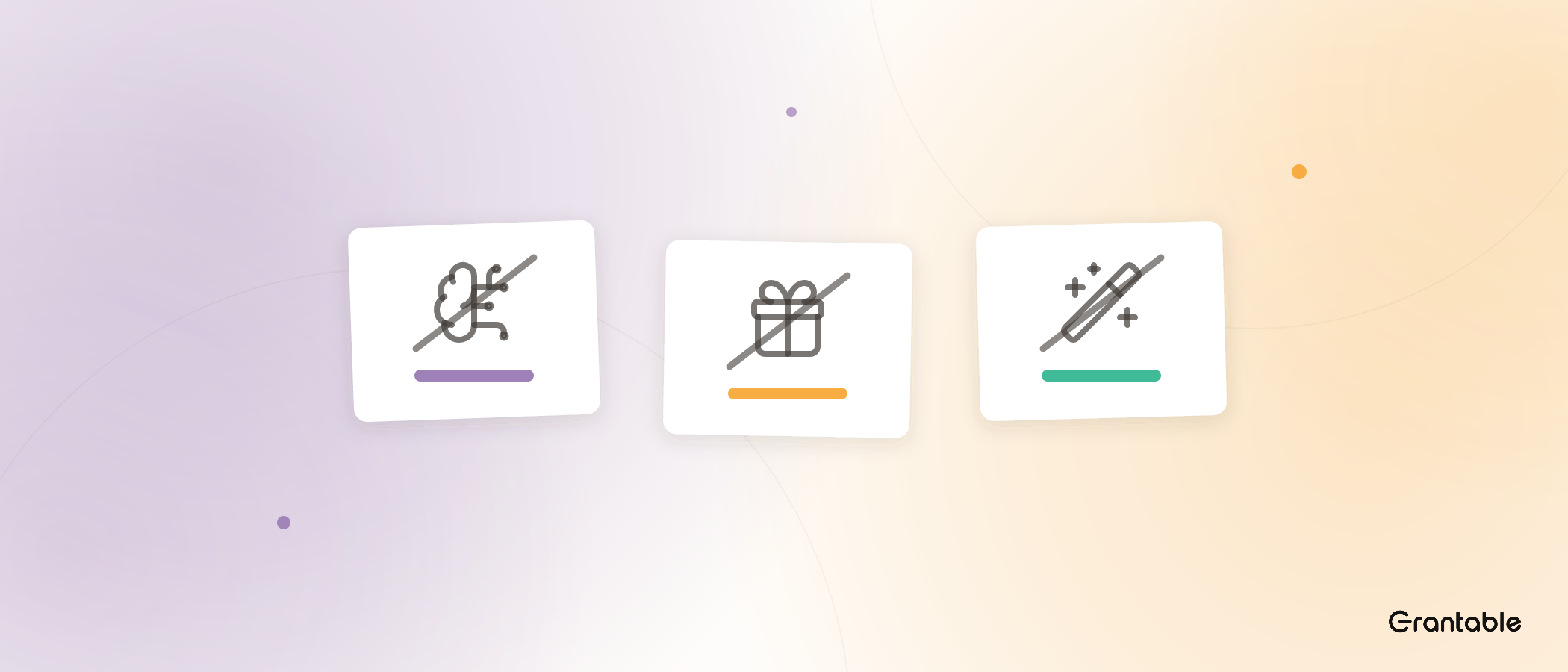
The three misconceptions that hold grant teams back
I spend a lot of time talking with grant professionals about AI. At conferences, on demo calls, in Slack groups, on webinars. And there's a pattern. The people who struggle with AI — who try it once and give up, or who use it but never trust it — almost always have the same three misconceptions about how the technology actually works.
These aren't stupid mistakes. They're reasonable assumptions based on how AI is marketed, how it's talked about in the media, and how most people first encounter it. But they're wrong. And getting them wrong means you'll either avoid AI entirely (leaving real leverage on the table) or use it in ways that create more problems than they solve.
So let's bust them, one at a time.
Misconception #1: AI "knows" things
This is the big one. When people talk about AI, they use knowledge language. "The AI knows about grant writing." "It knows what funders want." "It knows the data." Every word in those sentences is doing the wrong work.
AI doesn't know anything. Not in the way you know things, not in the way your intern knows things, not in the way Google knows things. What large language models do is predict the next word. That's it. They've been trained on enormous amounts of text, and they've learned statistical patterns about which words tend to follow which other words in which contexts. When you ask an AI to write a needs statement, it's not drawing on understanding of your community. It's generating a sequence of tokens that statistically resembles a needs statement based on the millions of needs statements it was trained on.
This distinction isn't academic. It has direct, practical consequences for how you use these tools.
Here's what this means in practice:
- AI will fabricate citations. It's not lying. It's predicting what a citation would look like in that context, and it generates something plausible. If you don't verify every fact, you're gambling your credibility on statistical patterns.
- AI will contradict itself. It has no persistent beliefs. Ask it the same question twice in different ways and you may get different answers. There's no internal consistency engine.
- AI will confidently produce garbage. The model's confidence level is completely unrelated to its accuracy. A hallucinated statistic sounds exactly as authoritative as a real one. The fluency is the trap.
None of this means AI is useless. It means AI is a power tool, not a consultant. You wouldn't hand a circular saw to someone and say "build me a house." You'd give them plans, materials, measurements, and supervision. Same principle.
The organizations getting real value from AI in their grant work have internalized this. They provide the knowledge — their programs, their data, their voice, their history — and let the AI provide the speed. The AI handles the mechanical work of drafting and formatting. The human handles everything that requires actual understanding.
The Knowledge Test
Before trusting any AI output, ask yourself three questions:
- Did I supply the facts? Any factual claim in the output should trace back to something you or your documents provided. If you can't find the source, assume the AI invented it.
- Does this match my actual program? Read the output as if a new staff member wrote it. Does it describe your real work, or a plausible-sounding version of it?
- Would I stake my reputation on this? Because if you submit it, you are. AI doesn't take responsibility. You do.
Misconception #2: Free tools are fine for organizational work
This one makes me genuinely nervous. I talk with grant teams who are pasting donor lists, financial data, program participant information, and internal strategy documents into free AI chatbots — and have no idea what happens to that data afterward.
Here's what happens: on most free tiers, your input is used to train the model. That's the business model. You're not paying with money, so you're paying with data. The terms of service on free versions of most major AI platforms explicitly state that your inputs may be used to improve their models. That means your proprietary organizational information — your budgets, your donor relationships, your program data — becomes training fodder that could surface in outputs for anyone.
This isn't a conspiracy theory. It's the terms of service. Most people just don't read them.
Now, this doesn't mean paid tools are automatically safe. You still need to check. But the economics are different. When you're paying for a service, the provider has a financial incentive to protect your data — because if they mishandle it, they lose a customer. When you're using a free tool, there's no such incentive. Your data is the revenue stream.
For grant professionals specifically, this matters more than you might think:
- Funder relationships are sensitive. Information about your funder strategy, cultivation plans, and giving history is competitive intelligence. You wouldn't email it to a stranger.
- Program participant data is protected. Depending on your programs, you may be handling information subject to HIPAA, FERPA, or other privacy regulations. Pasting it into an unvetted AI tool could be a compliance violation.
- Your proposals are intellectual property. The narratives, logic models, and evaluation frameworks you've developed represent years of organizational learning. They shouldn't become training data for a model that helps your competitors.
Security and data handling
Grantable completed a SOC 2 Type 2 examination covering April 9 – July 9, 2025, and is currently selecting a new independent firm for the next one. Your data is encrypted, access-controlled, and never used for model training. When your board or your funders ask about data security, our current audit status is published on our trust page.
The fix here isn't complicated. Use paid tools with clear data policies. Read the terms of service — specifically the sections about data retention and model training. Ask your vendor directly: "Is my input data used to train your models?" If they can't answer clearly, that's your answer.
The Data Safety Checklist
- Check the tier. Are you on a free tier, a paid individual plan, or an organizational/enterprise plan? Data policies differ by tier, even within the same tool.
- Read the training clause. Search the terms of service for "training," "improve," or "model." If your inputs are used for model improvement, that's a red flag for organizational data.
- Ask about retention. How long does the platform store your inputs? Can you delete them? Is data retained even after account deletion?
- Check for compliance certs. SOC 2, HIPAA BAA, GDPR compliance — these aren't marketing buzzwords. They're independently audited security frameworks. If your AI vendor doesn't have them, ask why.
- Create an approved tools list. Don't leave it to individual staff to evaluate AI tools. Make the decision at the org level, document it, and enforce it.
Misconception #3: AI either works or it doesn't
The third misconception is the one that costs people the most opportunity. It's the belief that AI is a binary — either it produces great output or it produces junk, and there's nothing you can do to influence which one you get.
The truth is that prompting skill is real, significant, and learnable leverage. The difference between a lazy prompt and a well-structured one isn't incremental. It's the difference between output you throw away and output you can actually build on. I'd estimate it at a 10x gap, minimum.
Most people who "tried AI and it didn't work" typed something like: "Write a grant proposal for our after-school program." And what they got back was vague, generic, and useless. They concluded that AI is vague, generic, and useless.
But the problem wasn't the AI. It was the prompt. You gave it nothing — no context about your organization, no details about the program, no information about the funder, no examples of your voice, no constraints on length or format. You got nothing back because you put nothing in.
Good prompting follows a structure. You don't need a PhD in computer science. You need the same skills you use when briefing a new grant writer on their first day: context, constraints, examples, and clear expectations.
The Prompt Quality Ladder
- Level 1 — The wish: "Write a needs statement." (Useless output guaranteed.)
- Level 2 — The task: "Write a 500-word needs statement about food insecurity in rural Appalachia for a USDA grant." (Better, but still generic.)
- Level 3 — The brief: Task + organizational context + funder priorities + specific data points you want included. (Output you can actually edit.)
- Level 4 — The collaboration: Brief + examples of your past writing + voice instructions + iterative feedback loop. (Output that sounds like your organization wrote it.)
- Level 5 — The system: All of the above, but automated. The context is pre-loaded, the voice is configured, the workflow is structured. You just point and execute. (This is where purpose-built tools live.)
Most people give up at Level 1 or 2. The ones who push to Level 3 and 4 are the ones who come back from conferences saying "AI changed my workflow." The ones at Level 5 are the ones whose colleagues can't figure out how they're submitting twice as many proposals without hiring additional staff.
The gap between these levels isn't talent. It's structure. And the good news is that you don't have to build that structure yourself.
Content Library
Grantable's Content Library stores your past proposals, program descriptions, data points, and organizational documents. Every time the AI drafts, it pulls from your real work — not from a blank slate. You're starting at Level 4 without building the context stack manually.
AI Helper
Grantable's AI Helper structures the prompting for you. Instead of crafting a perfect prompt from scratch, you work through a guided plan-review-execute cycle that breaks complex proposals into manageable sections. The prompting architecture is built into the workflow — you provide the judgment, the tool provides the structure.
What getting it right actually looks like
Let me tie these three together, because they're connected.
If you understand that AI doesn't know things (Misconception #1), you'll stop expecting it to produce accurate output from thin prompts. You'll start feeding it your actual organizational knowledge — your documents, your data, your history.
If you understand that free tools monetize your data (Misconception #2), you'll invest in a paid platform with real security certifications. You'll stop pasting sensitive information into tools that treat your inputs as training data.
If you understand that prompting skill is real leverage (Misconception #3), you'll either develop those skills yourself or adopt a tool that builds them into the workflow. Either way, you'll stop dismissing AI based on the results of a lazy experiment.
These three shifts — from blind trust to informed skepticism, from free tools to secure ones, from one-shot prompts to structured workflows — are the difference between grant professionals who find AI useless and grant professionals who find it indispensable.
What to do this week
- Audit your assumptions. Have you been treating AI like it "knows" your field? Start treating it like a fast drafting engine that needs your knowledge to produce anything useful.
- Check your tools. Are you or anyone on your team using free-tier AI for organizational work? Pull up the terms of service. Search for the word "training." If your data is being used, switch to a paid tier or a different tool.
- Test your prompts. Take the last prompt you gave an AI tool and score it on the Prompt Quality Ladder. If you're at Level 1 or 2, try rebuilding it at Level 3 — add organizational context, funder details, and specific data points. Compare the output.
- Share this with your team. These misconceptions are widespread. The faster your whole team understands how AI actually works, the faster you can adopt it effectively instead of arguing about it abstractly.
AI is the most significant productivity tool to hit the grant sector in decades. But only if you understand what it is, protect your data, and learn to communicate with it effectively. Get these three things right and the rest follows.